Hispaniolan Trogon in Los Haitises: The Island's Colorful Forest Bird
Among the many birds associated with the Dominican Republic's tropical forests, few are as visually distinctive as the Hispaniolan trogon (Priotelus roseigaster). Its green upper body, gray chest, vivid red belly and long tail make it one of the most memorable birds native to Hispaniola.
Known locally by names including papagayo, the Hispaniolan trogon belongs to the family Trogonidae. It is endemic to Hispaniola, meaning its natural range is restricted to this Caribbean island, which is shared by the Dominican Republic and Haiti.
Los Haitises National Park is included in a regional bird checklist that records the species. The park's natural landscape makes it an interesting destination for learning about the island's forest biodiversity, although visitors should not assume that a sighting is guaranteed.
This guide explores how to recognize the Hispaniolan trogon, understand its habitat and behavior, and appreciate why protecting mature forests is important for native birds.
What Is the Hispaniolan Trogon?
The Hispaniolan trogon is a forest-dwelling bird belonging to the family Trogonidae. Its scientific name is Priotelus roseigaster.
It is one of the distinctive endemic birds of Hispaniola. Unlike parrots and parakeets, which have strong curved bills and often travel in noisy flocks, the trogon has a different body shape and feeding style.
Its appearance is particularly striking. The contrast between its green upperparts, gray chest and red belly makes it recognizable when a good view is available.
The species is also interesting from a Caribbean evolutionary perspective. The genus Priotelus has two living representatives: the Hispaniolan trogon and the Cuban trogon (Priotelus temnurus). Both are native to the Greater Antilles.
How to Recognize a Hispaniolan Trogon
The easiest way to identify this bird is to look for its combination of bright colors, distinctive tail and characteristic shape.
1. Green head, back and tail
The head, back and tail are predominantly bright green. This coloring can help the bird blend into leafy forest surroundings, especially when it remains still among branches.
2. Gray throat and chest
The throat and upper chest are gray, creating a noticeable contrast with the green back and red belly.
3. Bright red belly and rump
One of the species' most recognizable features is its red lower body. The belly and rump have vivid red coloring that stands out against the other plumage.
4. Long tail with white markings
The trogon has a long, flowing tail. White markings on the underside of the tail can be visible when the bird moves or changes position.
5. Yellow bill and orange eyes
Its short bill is yellow, while its eyes are orange. These details can help confirm identification when the bird is seen clearly through binoculars or a camera lens.
A distant bird may appear mostly green. Looking for the red belly and overall body shape helps distinguish it from other green forest birds.
Why Is the Hispaniolan Trogon Important to Los Haitises?
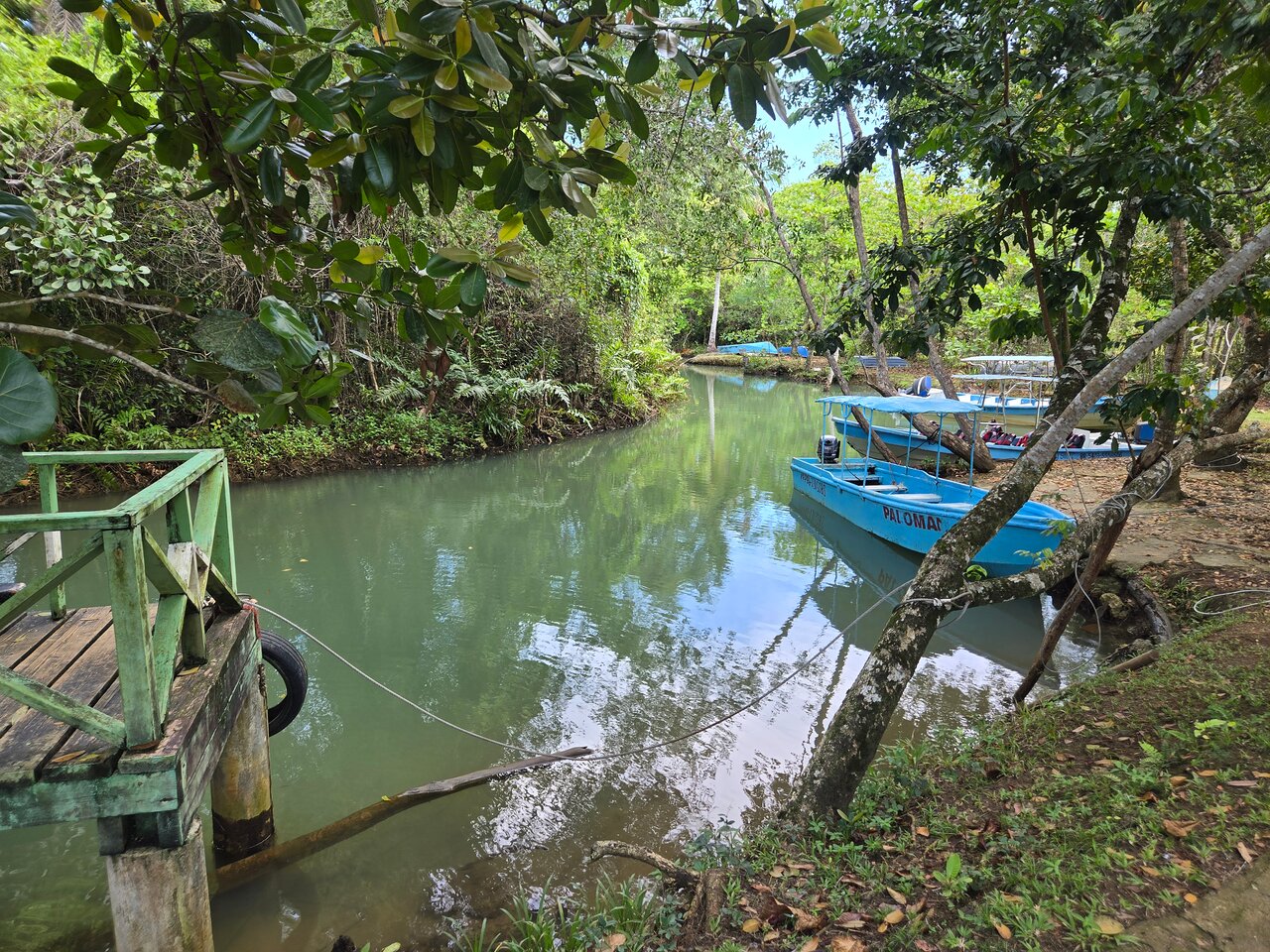
Los Haitises National Park is known for its limestone hills, tropical vegetation, mangroves, wetlands and coastal habitats. The park supports a diverse bird community, including species native to Hispaniola.
The Hispaniolan trogon appears on Avibase's Los Haitises National Park bird checklist, which was last modified on October 12, 2025. The checklist compiles bird records from multiple sources and is useful for understanding the region's recorded birdlife.
However, a checklist entry does not establish how frequently the trogon is currently seen in a particular part of the park, whether it breeds there, or which trails offer the best chances of observation.
The species is particularly associated with mature forest habitats. This makes the preservation of suitable wooded environments important when considering the wider conservation value of Los Haitises.
The park should be understood as part of the Dominican Republic's broader network of natural habitats rather than as the only place where this bird can survive.
Where Does the Hispaniolan Trogon Live?
The Hispaniolan trogon is native to Hispaniola and occurs in forested areas of the Dominican Republic and Haiti.
It has been recorded in different types of woodland, especially where mature trees and suitable vegetation remain.
Mature broadleaf forests
Mature broadleaf forests provide tree cover, shelter and natural food resources. These environments are particularly important for forest-dependent birds.
Historical field research in Haiti found many trogon observations in mature broadleaf forest. The researchers also described the species' dependence on mature trees for nesting and shelter.
Pine forests
The trogon has also been recorded in mature pine forest. In the Dominican Republic, Hispaniolan pine (Pinus occidentalis) is an important component of several mountain ecosystems.
Pine woodland can form part of the bird's habitat, although the availability of suitable nesting sites and food resources remains important.
Mountain forests
The species is associated with forested mountain environments across Hispaniola. Historical studies documented it in several mountain regions of the Dominican Republic and Haiti.
Its presence in these landscapes highlights the value of protecting forest habitats across different elevations.
Forests with limestone landscapes
The wider karst landscapes of Hispaniola contain a variety of forest environments. Where mature vegetation remains, these areas may support native wildlife.
For Los Haitises, it is important to distinguish between the park's documented regional bird records and confirmed observations at individual limestone hills or visitor sites.
What Does the Hispaniolan Trogon Eat?
The Hispaniolan trogon feeds on natural food found in its forest environment.
Its diet includes wild fruits and insects. It may also take other small animal prey.
This varied diet allows it to use different parts of the forest. A bird may search among branches and leaves for insects or visit fruit-bearing trees when food is available.
Feeding behavior is influenced by the habitat and the availability of natural resources. Different food sources may become more important at different times of the year.
The trogon's feeding activity is another reason mature forest ecosystems matter. Healthy woodland supports the plants and small animals that make up the bird's food supply.
Visitors should never attempt to feed wild birds. Artificial feeding can change natural behavior and expose wildlife to unsuitable food.
How Does the Hispaniolan Trogon Behave?
The Hispaniolan trogon is a forest bird that can be difficult to notice when it remains still among branches.
Its behavior and calls provide useful clues for people interested in observing it.
Perching quietly
The bird may remain perched for periods while watching its surroundings. Its green upperparts can blend into the forest canopy.
A patient observer may notice it when it changes position or turns to reveal its red belly.
Moving between branches
Trogons use trees for resting, feeding and nesting. They may move through the canopy and middle layers of forest while searching for food.
Calling from the forest
One of the species' most distinctive features is its voice. Historical natural-history descriptions record a loud but mellow call often represented as a repeated “krack-kaow” or “cuh-kwao.”
Calls may carry through forest vegetation, allowing people to detect the bird before seeing it.
However, sound recordings and call descriptions should be used carefully. Other forest birds may also produce loud or repeated sounds.
Living in forest habitat
The Hispaniolan trogon depends on wooded environments for important parts of its life cycle. Mature trees provide places to perch, shelter and potentially nest.
This makes forest quality more important than simply counting the number of trees in an area.
How Does the Hispaniolan Trogon Nest?
The Hispaniolan trogon nests in cavities. It can use holes in trees, including old nesting cavities created by the Hispaniolan woodpecker.
This relationship illustrates how different bird species can contribute to the availability of nesting habitat for one another.
Woodpeckers excavate cavities for their own nesting needs. Once a cavity is no longer occupied, another bird may use it.
Research in Ébano Verde Scientific Reserve
A research project studied the nesting biology of the Hispaniolan trogon in Ébano Verde Scientific Reserve in the Dominican Republic between December 2013 and December 2015.
Researchers installed artificial nesting structures in trees, mainly pines, and monitored their use.
The study recorded clutch sizes of two to four eggs in the nests observed. It also documented incubation, chick development and the participation of both adults in raising young.
The researchers reported that nesting activity varied between the two study years. They discussed severe drought during 2015 as a possible factor in the decline in breeding activity.
The study also recorded problems involving Philornis fly larvae in nestlings during part of the research. Later preventive measures were associated with improved results in the monitored nests.
These findings provide valuable information about the species, but they should not be interpreted as a complete description of nesting conditions throughout Hispaniola. The study was conducted at one scientific reserve.
Is the Hispaniolan Trogon Endangered?
The Hispaniolan trogon is included in the Dominican Republic's national Red List of threatened and protected fauna.
The national list issued under Resolution No. 0017/2019 classifies Priotelus roseigaster as Vulnerable. It also lists the local name papagayo.
This is a national conservation classification and should not be confused with a newly updated global population estimate.
The historical natural-history research on the species identifies habitat destruction as a major concern, particularly where mature broadleaf forests have been removed.
A reliable current population estimate for the species should not be invented. Its conservation needs are better understood through continued field surveys, habitat monitoring and protection of the forests where it occurs.
What Threats Does the Hispaniolan Trogon Face?
The species depends on forest habitats, especially mature woodland. Several environmental pressures can therefore affect its survival.
1. Loss of mature forest
Deforestation removes trees used for feeding, shelter and nesting.
The loss of mature forest can be particularly serious because young replacement trees may take many years to develop suitable cavities.
2. Forest fragmentation
When continuous woodland is divided into smaller patches, birds may have fewer connected areas in which to move and find resources.
Fragmentation can also make remaining forest patches more vulnerable to human disturbance.
3. Removal of large nesting trees
Because the trogon nests in cavities, the removal of old or mature trees can reduce the number of suitable nesting sites.
Protecting large trees is therefore important even when some younger vegetation remains nearby.
4. Environmental changes
Drought and other changes in environmental conditions can affect food availability and breeding activity.
The research at Ébano Verde documented variation in nesting activity between years and discussed drought as a possible influence.
5. Disturbance of sensitive habitats
Repeated disturbance around nesting trees and forest interiors can affect wildlife.
Visitors should avoid approaching possible nest cavities or making loud noises in sensitive areas.
Can Visitors See a Hispaniolan Trogon in Los Haitises?
The Hispaniolan trogon is included in the Los Haitises regional bird checklist, so it is relevant to the park's birdlife.
However, a sighting is never guaranteed. The bird may remain hidden among branches, move through forest away from visitor routes or be difficult to distinguish from other species.
Visitors interested in observing forest birds can improve their experience by following a few simple practices:
- Bring binoculars for viewing birds from a distance.
- Move slowly and avoid sudden noises.
- Listen for characteristic calls.
- Watch tree branches and forest edges patiently.
- Avoid approaching birds that appear to be nesting.
- Do not use food or recordings to attract birds.
- Follow park rules and the instructions of authorized guides.
If a guide or local naturalist identifies a trogon, ask which features distinguish it from other birds. This can make the experience more educational without requiring the bird to be approached.
How Can Visitors Help Protect the Hispaniolan Trogon?
Visitors can support the protection of native wildlife by respecting the environments on which birds depend.
Respect forest vegetation. Avoid breaking branches, removing plants or leaving marked visitor routes where access is restricted.
Keep noise under control. Quiet observation makes it easier to notice birds without unnecessarily disturbing them.
Never disturb nesting cavities. Do not touch tree holes, insert objects into cavities or attempt to photograph chicks at close range.
Avoid feeding wildlife. Let birds use their natural food sources.
Keep the park clean. Take rubbish away and avoid leaving plastics or food waste.
Choose responsible nature experiences. Support tourism providers that follow protected-area rules and do not encourage harmful wildlife interactions.
Protecting mature forest is especially important because it provides more than one resource. It supports nesting opportunities, food availability, shelter and the wider biodiversity of the landscape.
Why the Hispaniolan Trogon Deserves Attention
The Hispaniolan trogon is one of the most colorful birds native to Hispaniola. Its red belly, green back, long tail and distinctive call make it a remarkable part of the island's natural heritage.
Its life also demonstrates why mature forests matter. Trees provide the nesting cavities and feeding environments that allow this species to survive.
Los Haitises is an important place to learn about the Dominican Republic's natural diversity. Its bird checklist includes the Hispaniolan trogon, while its wider landscape contains a variety of forest, wetland and coastal habitats.
Whether or not you encounter the bird during a visit, understanding its ecology can make an exploration of Los Haitises more meaningful.
Protecting native birds begins with protecting the places they need to live.
Frequently Asked Questions
1. What is the scientific name of the Hispaniolan trogon?
Its scientific name is Priotelus roseigaster. It is a member of the family Trogonidae.
2. What does the Hispaniolan trogon look like?
It has a bright green head, back and tail, a gray throat and chest, a red belly and rump, a yellow bill and orange eyes.
3. Is the Hispaniolan trogon endemic to the Dominican Republic?
It is endemic to Hispaniola, the island shared by the Dominican Republic and Haiti. It is not restricted to the Dominican Republic alone.
4. Is the Hispaniolan trogon found in Los Haitises?
It appears on the Avibase Los Haitises National Park bird checklist. However, this does not guarantee regular sightings or confirm a breeding population at a specific visitor site.
5. What does the Hispaniolan trogon eat?
Its diet includes wild fruits and insects, along with other small animal prey.
6. Where does the Hispaniolan trogon build its nest?
It nests in tree cavities and may use old holes created by Hispaniolan woodpeckers.
7. Is the Hispaniolan trogon protected?
The Dominican Republic's national Red List issued under Resolution No. 0017/2019 classifies the species as Vulnerable.
8. What threatens the Hispaniolan trogon?
Major concerns include habitat destruction, loss of mature trees, forest fragmentation and disturbance of nesting habitat.
9. Can I photograph the Hispaniolan trogon?
You can photograph a wild bird when it is naturally visible, provided you maintain a respectful distance and do not disturb it or its nesting site.
10. What is the local name for the Hispaniolan trogon?
The Dominican national Red List records the common name papagayo. Other local names may vary by region.
Explore the Natural Landscapes of Los Haitises
Los Haitises National Park offers visitors an opportunity to learn about tropical forests, mangroves, limestone landscapes and the wildlife of the Dominican Republic.
A nature-focused visit can be rewarding even when a particular bird is not seen. The most important part of responsible wildlife tourism is respecting the habitats that support native species.
Before planning an excursion, confirm current access conditions, permitted routes and available services directly with the operator.
Discover Los Haitises: Visit LosHaitisesParkTours.com for destination information and available nature-tour options.
Local explorer & expert guide in Birdwatching Guide.


