Spotted Rail in Los Haitises: Secretive Wetland Bird and Its Hidden Lifestyle
Some of the most fascinating birds in Los Haitises National Park are not the easiest to see. While herons, pelicans, and other waterbirds may be visible in open areas, certain wetland species spend much of their time hidden among grasses, reeds, and dense vegetation.
The Spotted Rail (Pardirallus maculatus) is one such bird. It belongs to the rail family, Rallidae, and is known for its distinctive black-and-white markings, long bill, reddish legs, and secretive behavior.
Unlike birds that regularly swim in open water, the Spotted Rail often stays close to thick wetland cover. It moves quietly through vegetation, searches for food along muddy edges, and can disappear quickly when disturbed.
The species is particularly interesting in the Dominican Republic because it has been recorded at several locations on Hispaniola, including documented sites in the Los Haitises region. These records make it a valuable subject for anyone interested in the less familiar wildlife of the national park.
This guide explains how to identify the Spotted Rail, understand its behavior, recognize its habitat, and appreciate why observing this elusive bird requires patience.
Is the Spotted Rail Found in Los Haitises National Park?
Yes. The Spotted Rail is included in the available Los Haitises National Park bird checklist under its scientific name, Pardirallus maculatus.
There is also historical evidence of the species in the park itself. A scientific paper published in 2017, reviewing observations of rare rails on Hispaniola, lists an early August 2002 record from Caño Hondo in Los Haitises National Park.
The same paper documents another observation at Paraíso Caño Hondo on December 14, 2014. It also records a Spotted Rail in a wetland west of Sabana de la Mar on December 13–14, 2014.
These records are especially useful because they go beyond a general island-wide distribution map: they identify actual locations in the wider Los Haitises and Sabana de la Mar area.
However, historical records do not establish how frequently the bird can be seen today. The Spotted Rail is secretive, and visitors should not expect a guaranteed sighting on an ordinary park excursion.
For birdwatchers, the important lesson is that Los Haitises has documented records of this species, but finding it requires suitable habitat, quiet observation, and good fortune.
How to Identify a Spotted Rail
The Spotted Rail has a distinctive appearance, although its markings can be difficult to appreciate when it is moving through dense vegetation.
Adults generally measure around 25–28 centimeters in length. Their body pattern combines dark feathers, pale spots, and contrasting bars.
1. Spotted head and neck
The head, neck, and upper breast usually show dark plumage marked with small white spots or streaks.
These markings create a speckled appearance that gives the species its common name.
2. Barred underparts
The breast, belly, and flanks can display prominent black-and-white barring.
The pattern becomes particularly noticeable when the bird steps into an open patch of wetland vegetation.
3. Brown upperparts
The back and wings have brownish tones, often with pale streaking or mottling.
This coloring helps the bird blend into dry grasses, reeds, and wetland vegetation.
4. Long greenish-yellow bill
One of its most useful identification features is its relatively long bill.
The bill is generally greenish-yellow, with a small reddish area near the base of the lower mandible.
It is adapted for probing soft mud and searching for small animals.
5. Reddish legs and feet
The legs and feet are generally pinkish-red or reddish.
They help the bird walk through wet ground and move between dense vegetation.
6. White throat and undertail markings
The throat and feathers beneath the tail can show white areas. These details may become visible when the bird changes posture or raises its tail.
Not every individual looks exactly the same. Descriptions of the species recognize different plumage variations, including darker and more heavily barred forms.
Young birds are generally browner and less sharply marked than adults.
Why Is the Spotted Rail So Difficult to See?
The Spotted Rail is a secretive wetland bird. Its lifestyle makes it much harder to observe than species that regularly feed in open water.
There are several reasons for this.
It prefers dense vegetation
The bird spends much of its time among grasses, reeds, rushes, and other wetland plants.
These environments provide protection and food, but they also make the bird difficult to see from a distance.
It moves quietly
Rather than remaining in one exposed position, the Spotted Rail can walk between vegetation stems and disappear behind cover.
Its relatively narrow body helps it move through dense plants.
It avoids open areas
The bird may enter exposed patches to feed, but it generally benefits from remaining close to protective vegetation.
When disturbed, it can run quickly into cover.
It is often detected by sound
In some situations, calls provide the first indication that a Spotted Rail is nearby.
A birdwatcher may hear a harsh call from inside the marsh without ever seeing the bird.
Its behavior is not limited to daylight
Although it can be active during the day, the species may also call at night. This makes its behavior more difficult to predict than that of some familiar waterbirds.
These characteristics explain why the Spotted Rail is an interesting species for patient wildlife observers rather than visitors expecting an easy photograph.
Where Does the Spotted Rail Live?
The Spotted Rail is associated primarily with freshwater wetlands and places where thick vegetation grows in or beside shallow water.
Its habitat can include:
- Freshwater marshes
- Wet grasslands
- Reed beds
- Rush-covered wetlands
- Marshy edges of ponds and lagoons
- Overgrown drainage ditches
- Flooded fields
- Rice-growing areas with suitable vegetation
The presence of dense cover is particularly important. Wetland plants provide places to hide, search for food, and potentially nest.
In the Dominican Republic, the species has been documented at several wetland locations, including areas near Nagua, Laguna Limón, Monte Plata, Montecristi, and Los Haitises.
The 2017 research paper by Miguel A. Landestoy T. includes records from Caño Hondo and Paraíso Caño Hondo, making the park region particularly relevant to understanding the species on Hispaniola.
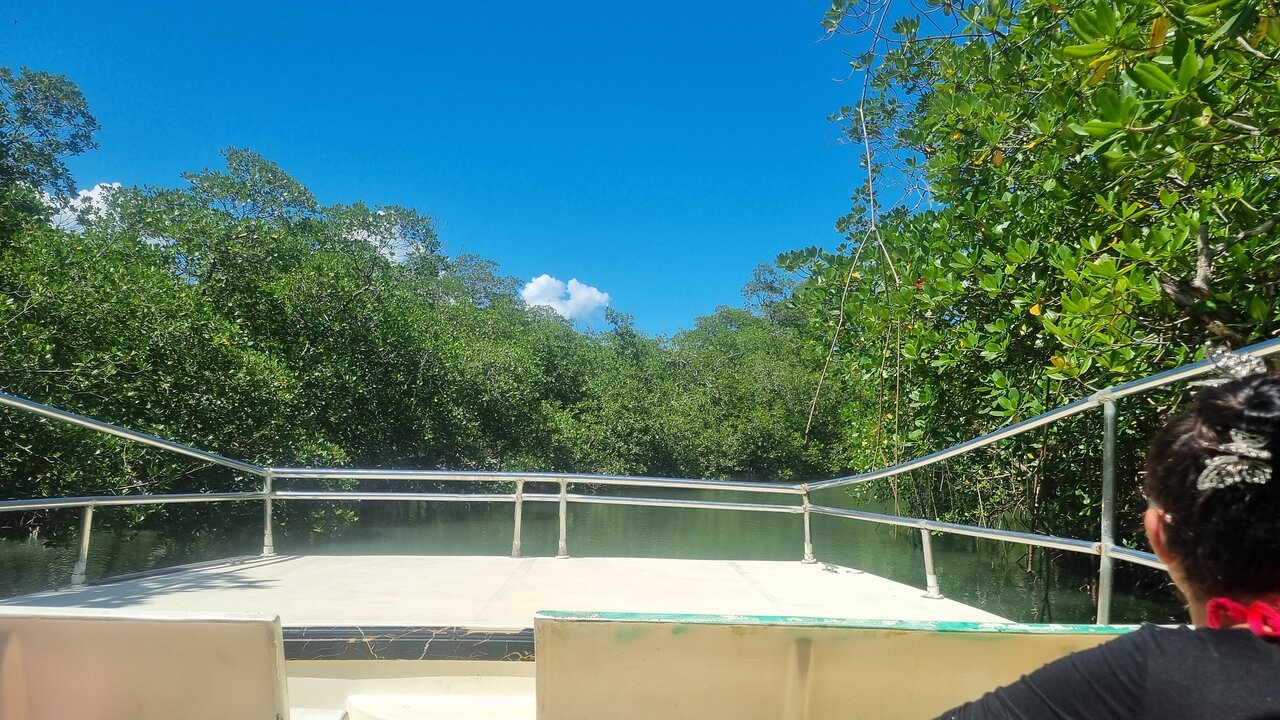
It is important not to assume that all mangrove channels are suitable Spotted Rail habitat. The bird is more closely associated with freshwater marshes and dense wetland vegetation than with open tidal waterways.
What Does the Spotted Rail Eat?
The Spotted Rail is a wetland forager with a diet that includes small animals and some plant material.
Its long bill is useful for searching through mud, shallow water, and wet vegetation.
Its food can include:
Aquatic snails: Snails are an important documented food source. Research on Hispaniola has described the bird carrying an apple snail in its bill.
Insects: Adult insects and their larvae are part of its diet.
Earthworms: It can search in soft wet ground for earthworms and similar prey.
Other invertebrates: Small wetland animals provide additional food.
Small fish: It may take small fish when available.
Aquatic vegetation: Some plant material, including pondweed, can also be consumed.
The mixture of food sources allows the Spotted Rail to use different parts of a wetland.
An Interesting Feeding Habit: Eating Aquatic Snails
One particularly interesting aspect of the Spotted Rail's feeding behavior involves aquatic snails.
Research published by Miguel A. Landestoy T. in 2017 discusses observations of Spotted Rails carrying apple snails (Pomacea canaliculata) in the Dominican Republic.
The study also describes shell accumulations associated with feeding sites at Laguna de Cabral. These structures were found among wetland plants and contained empty snail shells.
This behavior is interesting because it provides evidence of how the bird uses its surroundings to handle food.
Rather than simply swallowing every food item where it finds it, the Spotted Rail may carry snails into sheltered vegetation before consuming them.
The observation highlights the importance of small wetland animals in the bird's diet.
It also shows why studying secretive rails can reveal ecological details that casual wildlife viewing may miss.
How Does the Spotted Rail Move Through Wetland Vegetation?
The Spotted Rail has a body shape well suited to moving through thick marsh plants.
Its relatively narrow body helps it pass between stems, while its strong legs allow it to walk and run across soft wet ground.
Its movement often includes:
Walking through reeds and grasses
The bird moves between vegetation stems, searching for food and avoiding exposed areas.
Running into cover
When disturbed, it can move rapidly into nearby vegetation.
Wading in shallow water
It searches for prey along wetland edges and in shallow water.
Probing in mud
Its long bill helps it investigate soft mud for insects, worms, snails, and other small animals.
Swimming when necessary
Although it is not usually observed swimming in open water like a duck, the Spotted Rail is capable of swimming when conditions require it.
It can also use its wings to help move through difficult vegetation.
These behaviors allow it to exploit wetland environments that are less suitable for birds that depend on open water.
What Does the Spotted Rail Sound Like?
The Spotted Rail produces distinctive vocalizations that can help birdwatchers detect it.
Its calls have been described as harsh, rasping, and repeated. Some vocalizations begin with a short grunt before developing into a louder screeching series.
Other calls may sound like deep, rough notes repeated in a rhythm that becomes faster.
When disturbed, the bird may produce short, sharp calls.
It can also vocalize at night.
For birdwatchers, learning the species' calls can be valuable because the bird may remain hidden even when it is nearby.
However, not every sound heard in a marsh belongs to a Spotted Rail. Other rails, frogs, insects, and wetland animals can also produce distinctive calls.
Recordings and field guides can help with identification, but observations should be made carefully.
Avoid playing recorded calls to attract birds unless this is permitted under an appropriate research or conservation protocol. Playback can disturb wildlife, particularly during breeding periods.
Spotted Rail Nesting and Breeding Behavior
The breeding biology of the Spotted Rail on Hispaniola is not fully understood.
Research published in 2017 noted that, although the species has been recorded on the island for many years, confirmed nesting evidence was limited.
A male collected in June 1978 reportedly had enlarged reproductive organs, suggesting breeding condition, but this does not establish a complete local breeding calendar.
Across its wider range, the Spotted Rail generally builds a nest low in wetland vegetation, often close to or just above water.
The nest may be a platform made from grasses and rushes.
The breeding season varies geographically, so information from other countries should not be treated as proof of the exact nesting period in Los Haitises.
For visitors, the most important point is to avoid entering dense marsh vegetation or approaching areas where nesting activity may be taking place.
Is the Spotted Rail Rare in the Dominican Republic?
The Spotted Rail has historically been described as rare and local on Hispaniola.
Its secretive behavior makes it difficult to study, and the number of documented observations is relatively limited compared with more visible wetland birds.
The 2017 study by Landestoy reviewed historical and more recent Dominican Republic records and showed that the known distribution was broader than earlier accounts suggested.
Among the locations included in the research were:
- Madre Vieja near Nagua
- Pimentel
- Laguna Limón in El Seibo Province
- Wetlands near Sabana de la Mar
- Caño Hondo in Los Haitises
- Paraíso Caño Hondo
- Laguna Mata La Vieja in Monte Plata
- Wetlands in Montecristi
These observations are important because they demonstrate that the species has been recorded across several parts of the country.
However, a wider distribution does not necessarily mean that the bird is common. Its actual population size and current local status require more monitoring.
Is the Spotted Rail Endangered?
The Spotted Rail's conservation status should be considered carefully because its global and local situations are not necessarily the same.
Some global species references classify it as Least Concern. However, older Dominican Republic conservation literature described the species as Vulnerable nationally.
These classifications answer different questions.
A species may have a broad distribution across several countries and still have small, isolated, or poorly documented populations in particular regions.
For the Dominican Republic, the 2017 research emphasized that the species was poorly known and that its status and breeding biology required further study.
Wetland habitat degradation is a potential concern because the Spotted Rail depends on suitable marsh vegetation and shallow-water environments.
Protecting wetlands, maintaining water quality, and avoiding unnecessary disturbance are important steps toward conserving this and other secretive waterbirds.
Where Can Birdwatchers Look for the Spotted Rail Around Los Haitises?
The documented records from Caño Hondo and Paraíso Caño Hondo make the Los Haitises region an important place in the species' Dominican Republic history.
However, these records should not be interpreted as a promise that a visitor will find the bird at those locations today.
If Spotted Rail observation is a priority, birdwatchers should focus on the ecological characteristics of its habitat:
- Dense freshwater vegetation
- Marshy ground
- Shallow water
- Reeds and rushes
- Quiet wetland margins
- Places with suitable feeding cover
A few practical observation tips can help:
Move quietly. Sudden noise can cause hidden birds to retreat deeper into vegetation.
Watch vegetation edges. The bird may briefly emerge where open mud meets dense cover.
Listen carefully. Calls can provide clues to the presence of a hidden rail.
Use binoculars. They allow closer observation without approaching the bird.
Be patient. A Spotted Rail may remain concealed for a long time before crossing an opening.
Ask about habitat access. Not every standard excursion visits freshwater marsh habitat suitable for this species.
A responsible birdwatching experience should never involve forcing a bird out of cover.
Spotted Rail vs. Common Gallinule: How Are They Different?
The Spotted Rail and Common Gallinule both belong to the rail family, but they look quite different.
The Common Gallinule is generally easier to recognize in open water because of its dark body, red bill, and white side stripe.
The Spotted Rail has a much more complex plumage pattern.
Its head and upper breast have white spots on dark feathers, while the lower body shows contrasting black-and-white bars.
The Spotted Rail also has a longer greenish-yellow bill and reddish legs.
Their behavior differs as well. Common Gallinules are frequently seen swimming and walking in open wetland areas, while Spotted Rails are more likely to remain hidden in dense vegetation.
Spotted Rail vs. American Coot
The American Coot is another rail-family species recorded in Los Haitises.
Its dark body and white bill create a very different appearance from the Spotted Rail.
The American Coot has lobed toes adapted for swimming, and it is often observed in open water.
The Spotted Rail has a long bill, reddish legs, spotted upperparts, and barred underparts. It is generally more associated with thick marsh vegetation.
A simple identification rule is to look for the overall body pattern:
- Mostly dark body with a white bill: American Coot.
- Dark-and-white spotted and barred plumage with a long bill: Spotted Rail.
Responsible Birdwatching in Los Haitises
The Spotted Rail is exactly the kind of bird that benefits from careful observation.
Because it depends on dense wetland vegetation, disturbing its habitat can affect feeding, shelter, and potential nesting areas.
Visitors should follow these practices:
- Remain on permitted visitor routes.
- Avoid entering marsh vegetation.
- Do not chase birds into open areas.
- Never approach nests or chicks.
- Keep noise levels low.
- Do not feed wild birds.
- Avoid damaging reeds, grasses, or aquatic plants.
- Follow instructions from authorized park personnel.
- Use binoculars or a camera zoom instead of moving closer.
Protecting hidden wetland habitats is just as important as protecting the more visible landscapes of Los Haitises.
Why the Spotted Rail Matters to Los Haitises' Biodiversity
The Spotted Rail demonstrates that some of the park's most interesting wildlife is not necessarily visible during a typical excursion.
Its presence in the available checklist and its documented records at Caño Hondo and Paraíso Caño Hondo highlight the importance of the region's wetland habitats.
It also shows how much remains to be learned about the ecology of secretive Caribbean birds.
Research into its feeding habits, distribution, and breeding behavior helps improve our understanding of wetlands and the wildlife that depends on them.
For travelers, learning about the Spotted Rail offers a different way to appreciate Los Haitises. Instead of focusing only on large, easily photographed animals, visitors can begin to recognize the ecological importance of smaller and less conspicuous species.
Frequently Asked Questions
1. Is the Spotted Rail found in Los Haitises National Park?
Yes. It appears in the available Los Haitises bird checklist. Scientific research also documents historical observations at Caño Hondo in 2002 and Paraíso Caño Hondo in December 2014.
2. What is the scientific name of the Spotted Rail?
Its scientific name is Pardirallus maculatus.
3. What does a Spotted Rail look like?
It has dark plumage with white spots on the head and upper body, black-and-white barred underparts, a long greenish-yellow bill, and reddish legs.
4. Why is the Spotted Rail difficult to see?
It spends much of its time in dense wetland vegetation, moves quietly, and quickly retreats into cover when disturbed.
5. What does the Spotted Rail eat?
Its diet includes aquatic snails, insects, insect larvae, earthworms, other invertebrates, small fish, and some aquatic plants.
6. Does the Spotted Rail live in mangroves?
It is primarily associated with freshwater marshes, reed beds, wet grasslands, and other densely vegetated wetlands. It should not be described as a specialist of tidal mangrove channels.
7. Can the Spotted Rail swim?
Yes. It can swim when necessary, although it is more often associated with walking and foraging through wetland vegetation.
8. What does the Spotted Rail sound like?
It produces harsh, rasping calls and repeated screeching notes. It may also make short grunting or sharp alarm sounds.
9. Has the Spotted Rail been recorded near Sabana de la Mar?
Yes. A 2017 scientific review lists a December 2014 record from a wetland west of Sabana de la Mar and another from Paraíso Caño Hondo in Los Haitises.
10. Is the Spotted Rail endangered?
Its global conservation category and local conservation situation should be distinguished. Historical Dominican Republic literature described it as Vulnerable, while some global references classify it as Least Concern.
11. Can visitors see the Spotted Rail during a Los Haitises excursion?
A sighting is possible but cannot be guaranteed. The bird is secretive, and the likelihood depends on suitable habitat, access, and local conditions.
Explore the Natural Wetlands of Los Haitises
Los Haitises National Park is known for its mangroves, limestone formations, caves, coastal landscapes, and diverse wildlife.
The Spotted Rail provides a reminder that the park's ecological value also lies in quieter places where small wetland birds live among grasses and reeds.
If you are planning a visit from Sabana de la Mar, explore available excursions and consider which natural environments are included in the itinerary.
Respect wildlife, follow park regulations, and appreciate the biodiversity of Los Haitises without disturbing the animals that make the area special.
Discover Los Haitises National Park and learn more about the remarkable wildlife of the Dominican Republic.
Local explorer & expert guide in Birdwatching Guide.