Water Temperature in Los Haitises National Park: Seasonal Changes, Groundwater and Tropical Aquatic Habitats
Introduction
Water temperature is an important environmental condition in Los Haitises National Park. It influences aquatic organisms, dissolved oxygen, water chemistry and the ecological processes taking place in rivers, springs, wetlands and mangrove channels.
Although Los Haitises is located in a tropical region, its water environments do not necessarily have identical temperatures. Shallow water exposed to sunlight can warm differently from groundwater emerging through a spring. Mangrove channels, shaded streams and open wetlands also experience different environmental conditions.
Rainfall, sunlight, vegetation, water depth and groundwater movement all contribute to these differences.
Understanding water temperature helps explain how aquatic habitats function and why regular environmental monitoring is useful for protecting the park.
1. Why Water Temperature Matters in Los Haitises
Water temperature affects many physical, chemical and biological processes.
It influences how quickly aquatic organisms use energy, how much oxygen water can hold and how certain chemical reactions occur.
In Los Haitises, these effects are relevant to several aquatic environments:
- Freshwater wetlands.
- Rivers and streams.
- Groundwater-fed springs.
- Mangrove channels.
- Coastal waters.
- Water-filled depressions and other wetland habitats.
A temperature change does not automatically indicate environmental damage. Natural conditions change throughout the day and across seasons.
However, unusually large or persistent changes may affect organisms and indicate that an aquatic habitat is experiencing additional environmental pressure.
2. What Determines the Temperature of Natural Water?
Several environmental factors influence water temperature.
Sunlight
Solar radiation is one of the main sources of heat for surface water.
Shallow areas exposed to direct sunlight can warm more quickly than deeper or shaded water.
Air temperature
Air temperature influences the exchange of heat between the atmosphere and the water surface.
However, water does not always change temperature as quickly as the surrounding air.
Water depth
Shallow water generally responds more quickly to changes in sunlight and air temperature.
Deeper water can have greater thermal stability, depending on water movement and mixing.
Vegetation
Trees and mangroves can create shade over waterways.
Shading reduces direct solar exposure and may help limit daytime heating in some locations.
Groundwater inflow
Groundwater may enter a river or wetland through springs, seepage zones or underground connections.
Because groundwater is partly protected from direct daily weather changes, it can sometimes help moderate the temperature of receiving surface water.
Water movement
Flowing water can transport heat from one location to another.
Mixing between different water sources can also influence local temperature conditions.
These factors operate together rather than independently.
3. The Influence of Los Haitises' Tropical Climate
Los Haitises is part of a tropical environment where rainfall, humidity and warm atmospheric conditions influence aquatic habitats.
The region experiences changing rainfall conditions during the year. These changes can influence the amount of water entering rivers, wetlands and groundwater systems.
Rainfall may affect water temperature in several ways:
- Rainwater can temporarily cool exposed surface water.
- Increased runoff can introduce water with a different temperature.
- Groundwater recharge can influence underground water movement.
- Higher water levels can change the depth and exposed surface area of wetlands.
- Cloud cover can reduce direct solar heating.
The exact response depends on the location, rainfall intensity and condition of the water body.
It is therefore not accurate to assume that all rivers and wetlands in Los Haitises become cooler or warmer in the same season.
4. Water Temperature in Rivers and Streams
Rivers and streams experience temperature changes as water moves through the landscape.
A river exposed to sunlight may warm more quickly than a stream flowing beneath dense vegetation.
Water temperature can also change when a river receives groundwater, tributary water or rainfall runoff.
In Los Haitises, river systems are connected to a wider karst landscape. Some surface water can interact with underground drainage pathways, while groundwater can emerge through springs.
This relationship makes river temperature useful for understanding more than atmospheric conditions alone.
Researchers can compare measurements at different points along a watercourse to investigate whether temperature changes are associated with shading, depth, flow or groundwater contributions.
5. Temperature of Groundwater and Natural Springs
Groundwater behaves differently from exposed surface water.
Underground water is protected from direct sunlight and rapid changes in air temperature. The surrounding geological materials also influence how quickly its temperature changes.
As a result, groundwater often has a more stable temperature than shallow surface water.
When groundwater emerges through a natural spring, it brings its underground thermal conditions into the surface environment.
In Los Haitises, springs are important parts of the karst water system. They connect underground water movement with rivers and wetlands.
A spring may therefore influence the temperature of the water around its discharge point.
However, the temperature of every spring should not be assumed to be identical. Groundwater depth, flow pathways, recharge conditions and mixing with surface water can produce local differences.
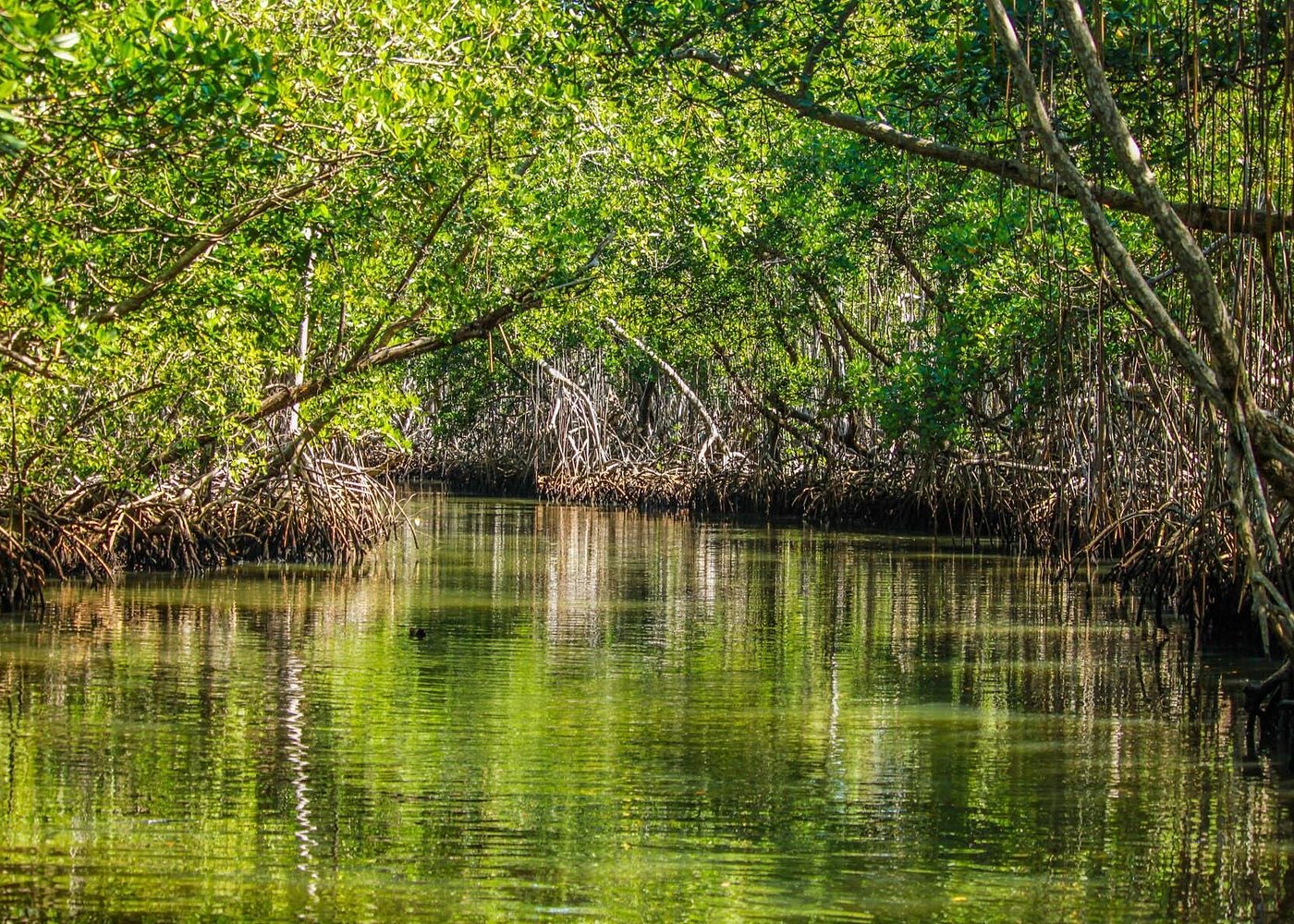
6. How Mangrove Forests Influence Water Temperature
Mangroves are an important feature of the coastal environment of Los Haitises.
Their dense vegetation can influence the amount of sunlight reaching the water.
Shade from mangrove trees
Mangrove branches and leaves can reduce direct solar exposure.
This may limit rapid warming in shaded channels compared with nearby open water.
Organic material
Mangrove forests contribute leaves, roots and other organic materials to the surrounding environment.
The decomposition of this material supports food webs and influences water chemistry. Biological activity associated with decomposition can also interact with oxygen conditions.
Tidal movement
Tides move water through mangrove channels and can mix water masses with different temperatures.
The amount of mixing depends on channel conditions, tidal stage and other local factors.
Water depth and channel shape
Narrow, shallow channels may respond differently to sunlight and water exchange than deeper or more open channels.
These processes help make mangrove water temperature an important subject in coastal ecosystem monitoring.
7. Water Temperature in Wetlands
Wetlands contain shallow water, vegetation and organic-rich sediment.
These characteristics can create different temperature conditions from those found in deeper rivers or groundwater-fed springs.
Some wetland areas receive strong sunlight, while others are shaded by vegetation.
Water depth also changes as rainfall and drainage conditions vary.
During periods of lower water levels, shallow areas may experience greater daily temperature fluctuations. When water levels rise, the increased volume and mixing may change the way heat is distributed.
However, the response differs among wetlands.
Los Haitises contains wetlands associated with its karst landscape and groundwater system. Research has investigated the relationships between wetlands, groundwater, springs and rivers, showing why these habitats should be studied as connected parts of the water system.
8. Historical Water Temperature Measurements in the Los Haitises Hydrogeological Region
A National Geological Service hydrogeological study provides useful historical context for understanding water temperature in the wider Los Haitises hydrogeological unit.
The report presents field measurements from water-sampling locations during its assessment period. The reported water temperatures ranged from approximately 21°C to 31°C.
The sampling locations included different environments, such as springs, surface waters and the wider regional study area.
These figures should be interpreted carefully.
They are historical measurements from particular sampling locations and dates. They are not a current average temperature for Los Haitises National Park, nor do they represent every river, spring or mangrove channel.
The report demonstrates that water temperature can vary across the wider hydrogeological region and that field measurements are more useful than assuming one temperature applies to the entire landscape.
9. Why Water Temperature Changes During the Day
Water temperature can change between morning, afternoon and nighttime.
Morning
After nighttime cooling, exposed surface water may begin the day at a lower temperature than it reaches later in the afternoon.
Afternoon
Solar radiation can increase the temperature of shallow water, especially in locations with limited shade.
Evening
As sunlight decreases, surface water gradually loses heat.
Night
Water continues exchanging heat with the surrounding environment. The amount of cooling depends on weather, cloud cover, wind, depth and water movement.
Groundwater-fed water bodies may show smaller daily temperature changes than shallow, exposed water.
For reliable environmental studies, researchers should record the time of each measurement rather than comparing readings without considering the time of day.
10. Seasonal Rainfall and Water Temperature
Seasonal rainfall can influence water temperature through several connected processes.
During wetter periods, increased rainfall and runoff may introduce additional water into rivers and wetlands.
This can change water depth, flow and mixing.
During drier periods, some shallow water bodies may become more exposed to direct sunlight. Lower water levels can also change the relationship between the water surface and surrounding vegetation.
However, there is no single seasonal temperature pattern that applies to every water environment in Los Haitises.
A shaded spring, an open wetland and a tidal mangrove channel may respond differently to the same weather conditions.
Monitoring should therefore compare similar habitats and sampling locations across different seasons.
11. The Relationship Between Water Temperature and Dissolved Oxygen
Water temperature influences the amount of oxygen that can dissolve in water.
Generally, cooler freshwater can hold more dissolved oxygen than warmer freshwater when other conditions are comparable.
This relationship is important because aquatic organisms depend on dissolved oxygen for respiration.
However, temperature is not the only factor controlling oxygen levels.
Dissolved oxygen is also affected by:
- Photosynthesis.
- Respiration.
- Decomposition of organic matter.
- Water movement.
- Mixing with the atmosphere.
- Depth and local habitat conditions.
For example, a shaded stream and a shallow wetland may have different oxygen conditions even if their temperatures are similar.
Scientists should measure temperature and dissolved oxygen together when assessing aquatic habitat conditions.
12. How Water Temperature Affects Aquatic Organisms
Aquatic organisms are adapted to particular environmental conditions.
Fish, aquatic invertebrates, microorganisms and other organisms can respond differently to changes in water temperature.
Temperature influences:
- Metabolic activity.
- Growth and development.
- Feeding behavior.
- Reproduction.
- Oxygen requirements.
- The distribution of suitable habitats.
Some organisms tolerate a relatively wide range of temperatures, while others are more sensitive.
Sudden changes may be particularly challenging for organisms that cannot move easily to another habitat.
In Los Haitises, the variety of rivers, wetlands and mangrove habitats means that aquatic organisms experience different local conditions.
Protecting habitat diversity helps maintain the environmental conditions required by different species.
13. Does Warmer Water Always Mean Poor Water Quality?
No. Naturally warm water is common in tropical environments.
Water temperature must be interpreted in relation to the habitat, season, time of day and local water sources.
For example, a shallow open wetland may naturally become warmer during a sunny afternoon. A groundwater-fed spring may remain more thermally stable.
Neither condition automatically indicates pollution.
However, an unusual and persistent temperature change can be important.
It may result from changes in water flow, vegetation cover, discharge conditions or other environmental influences.
Temperature monitoring becomes more useful when measurements are compared with historical records and appropriate reference locations.
14. How Scientists Measure Water Temperature
Water temperature is relatively easy to measure, but reliable results require consistent methods.
Researchers commonly use calibrated digital thermometers or multiparameter water-quality instruments.
A basic monitoring procedure includes the following steps.
Step 1: Select a sampling location
Choose a representative location in a river, spring, wetland or mangrove channel.
Step 2: Record the time and weather
Document the date, time, sunlight, cloud cover and recent rainfall where possible.
Step 3: Measure the water temperature
Place the temperature probe in the water at a consistent sampling depth.
Step 4: Allow the reading to stabilize
Wait until the instrument provides a stable measurement.
Step 5: Record the result
Record the temperature in degrees Celsius.
Step 6: Repeat the measurement
Repeat readings when appropriate to identify measurement errors or unusual variation.
Step 7: Compare locations
Compare similar habitat types and record differences between shaded and exposed locations.
For long-term monitoring, researchers should use consistent equipment, sampling depths and procedures.
15. Why Temperature Monitoring Should Include Other Water-Quality Measurements
Water temperature provides useful information, but it cannot describe the entire condition of an aquatic environment.
It is best interpreted alongside other measurements.
ParameterWhat it helps explainTemperatureThermal conditions of the waterDissolved oxygenOxygen available to aquatic organismspHAcidic or alkaline conditionsConductivityAmount of dissolved ionic substancesTurbidityCloudiness caused by suspended particlesAlkalinityCapacity to neutralize added acidWater levelChanges in depth and hydrological conditions
Combining these measurements can help researchers identify relationships between physical conditions and aquatic habitat quality.
For example, a temperature increase accompanied by lower dissolved oxygen may deserve further investigation.
It is important to consider natural daily and seasonal variation before concluding that an environmental problem exists.
16. Climate Change and the Future of Aquatic Temperature
Long-term changes in climate can influence aquatic environments.
Higher air temperatures may increase the potential for surface-water heating. Changes in rainfall can also affect water levels, runoff and groundwater recharge.
These processes may influence rivers, wetlands and mangrove habitats in different ways.
However, the future temperature of individual water bodies cannot be predicted from air temperature alone.
Researchers need long-term measurements of water temperature, rainfall, water levels and other environmental conditions to identify trends.
For Los Haitises, monitoring can help conservation managers understand whether changes are part of normal seasonal variation or indicate a longer-term environmental shift.
17. How Visitors Can Help Protect Aquatic Habitats
Visitors can help protect the natural water environments of Los Haitises through responsible behavior.
Useful practices include:
- Avoid throwing rubbish into rivers and mangrove channels.
- Do not pour chemicals, oils or soaps into natural water.
- Avoid damaging mangrove roots and wetland vegetation.
- Follow authorized boat routes and visitor instructions.
- Do not disturb aquatic wildlife.
- Avoid damaging springs, caves and other sensitive natural features.
- Follow the instructions of authorized guides and park authorities.
Vegetation is particularly important because it provides habitat and can influence shade, sediment movement and the condition of surrounding waterways.
Responsible visiting helps protect the natural processes that support the park's aquatic ecosystems.
Conclusion
Water temperature is an important part of the ecological and hydrological systems of Los Haitises National Park.
Sunlight, rainfall, water depth, vegetation, groundwater and tidal movement all influence the temperature of natural water.
Rivers, springs, wetlands and mangrove channels can therefore experience different thermal conditions, even within the same protected landscape.
Historical hydrogeological research provides water-temperature measurements for the wider Los Haitises region, but these values should not be treated as current or universal park measurements.
Regular monitoring, combined with measurements of dissolved oxygen and other water-quality indicators, can help scientists understand how aquatic habitats respond to environmental conditions.
Protecting the park's water systems also means protecting the mangroves, forests, wetlands and underground pathways that sustain them.
Frequently Asked Questions
1. Why is water temperature important in Los Haitises?
Water temperature influences dissolved oxygen, aquatic organisms, chemical processes and the ecological conditions of rivers, springs, wetlands and mangrove channels.
2. What is the water temperature in Los Haitises National Park?
There is no single temperature for the entire park. Historical measurements from the wider Los Haitises hydrogeological region reported approximately 21°C to 31°C at sampled locations. These are not current park-wide averages.
3. Are natural springs cooler than surface water?
Groundwater often experiences smaller daily temperature changes because it is protected from direct sunlight. However, the actual temperature depends on groundwater conditions and the surrounding environment.
4. Do mangroves influence water temperature?
Yes. Mangrove vegetation can shade water channels and reduce direct solar exposure. Tidal movement and channel depth also influence temperature.
5. Does rainfall change water temperature?
Yes. Rainfall can introduce water at a different temperature, increase water levels and change the mixing of surface water and groundwater.
6. Why can shallow wetlands become warmer?
Shallow water can respond relatively quickly to sunlight and changes in air temperature, particularly where vegetation provides limited shade.
7. Does warmer water contain less oxygen?
Generally, warmer freshwater can hold less dissolved oxygen than cooler freshwater under comparable conditions. Actual oxygen levels also depend on biological activity and water movement.
8. How do scientists measure water temperature?
They commonly use digital thermometers or multiparameter water-quality instruments, recording the temperature in degrees Celsius.
9. Can water temperature indicate pollution?
Temperature changes can provide useful warning information, but temperature alone cannot prove pollution. Researchers need additional measurements and comparisons with natural conditions.
10. How does climate change affect water temperature?
Changes in air temperature and rainfall can influence surface-water heating, water levels and groundwater recharge. Long-term monitoring is needed to understand local effects.
11. Why should water temperature be measured at different times?
Water temperature can change throughout the day. Repeated measurements help researchers understand daily variation and avoid misleading comparisons.
12. How can visitors protect the park's aquatic habitats?
Visitors should avoid littering, prevent chemical contamination, protect vegetation and follow authorized routes and park instructions.
Local explorer & expert guide in Birdwatching Guide.